

The scandinavian paradox: Sweden tests first total hydrogen ecosystem to break fossil dependence
The European race for energy autonomy and climate neutrality has just hit a new milestone in Northern Europe. The HiWHyV project has launched its strategic journey to demonstrate, for the first time and at a commercial scale, the simultaneous operation of an entire renewable hydrogen ecosystem: from clean generation to logistical distribution and final application in critical industrial sectors.
Unlike fragmented initiatives, HiWHyV stands out for its systemic approach. In a global context marked by supply chain vulnerabilities and the volatility of imported fossil fuels, this international consortium positions green hydrogen not merely as a decarbonization alternative, but as a fundamental pillar for the continent’s economic resilience and competitiveness.
A Transeuropean Alliance with Regional Impact
The deployment of HiWHyV is backed by a robust financial and cooperative framework. The project, which spans a six-year duration, brings together more than 40 strategic partners including private enterprises, regions, public bodies, and research institutes. The initiative is supported by a financial injection of nearly €20 million, co-funded by the Clean Hydrogen Partnership (CHP) and the European Union’s Horizon Europe framework program.
The quantitative goal is ambitious and clear: to reach a production capacity of 4,000 tonnes of renewable hydrogen per year by 2030. However, the true value-add of the project lies in its functional diversification. The produced energy vector will not be limited to a single use; instead, it will simultaneously drive high-impact, real-world applications ranging from the development of sustainable maritime transport fuels to the manufacturing of climate-friendly, low-carbon fertilizers for the agrifood sector.
The Architecture of the Nine Nodes
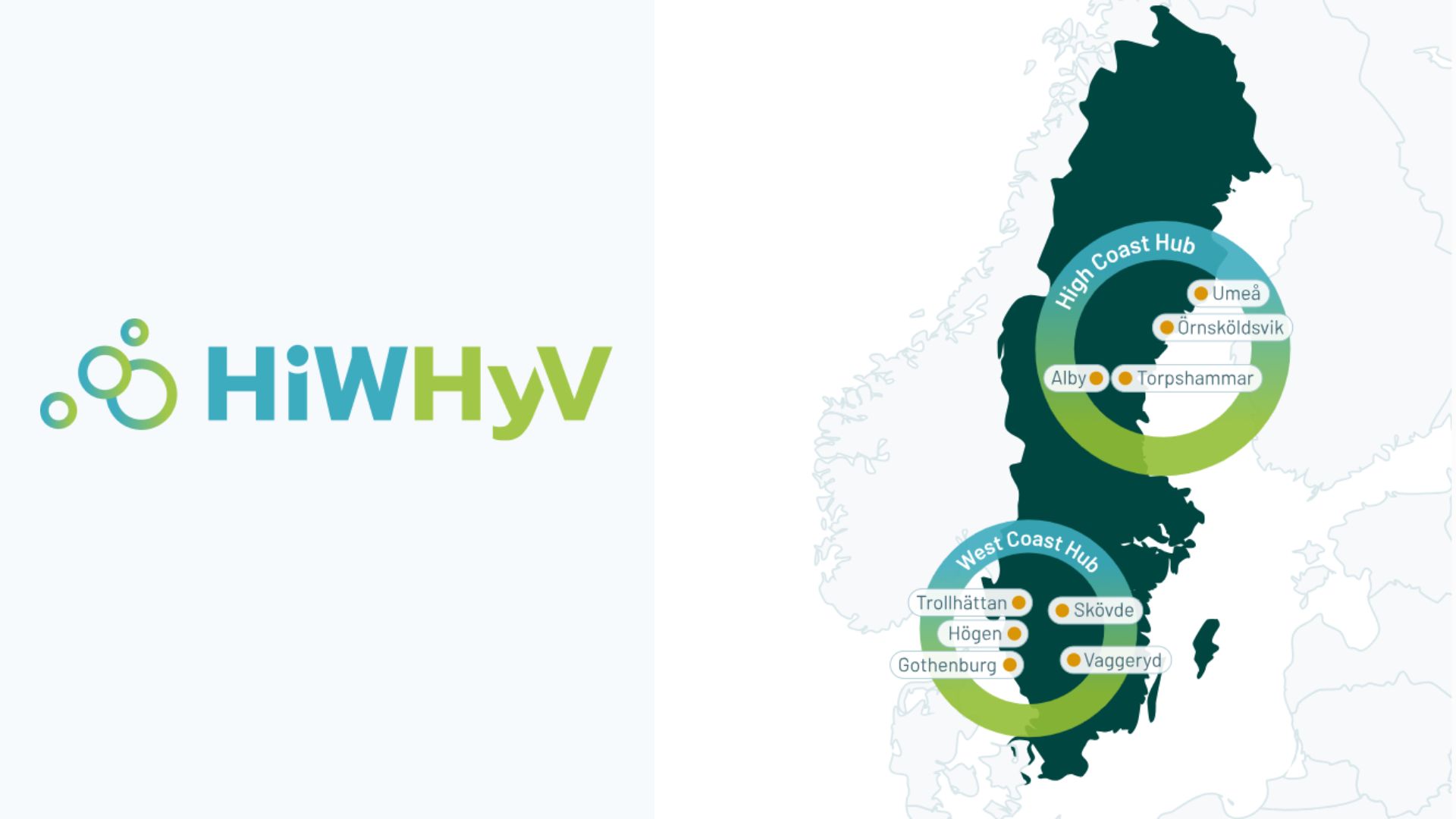
Geographically, the project is structured across a network of nine strategic nodes located throughout Swedish territory, with a sharp concentration in the High Coast (north) and the West Coast (south). These locations operate cohesively to form an integrated regional valley, proving the technical and commercial viability of the model at scale.
Beyond its direct impact on industrial revitalization and specialized job creation within Swedish regions, HiWHyV integrates organizations from various parts of Europe. The ultimate purpose of this distributed structure is knowledge transfer: the success models validated in the Scandinavian nodes will serve as a blueprint for replication across other hydrogen vectors and valleys in Southern and Central Europe, consolidating an interconnected network of clean energy infrastructure and expertise.
Interview | Alberto Herranz, Consulting and Training Technician at the Aragon Hydrogen Foundation
Behind the technical architecture connecting the Scandinavian nodes with the rest of the continent is the team from the Aragon Hydrogen Foundation. We spoke with Alberto Herranz, Consulting and Training Technician at the entity, to unpack the scope of Aragonese participation in this European milestone and the challenges of technological replication.
Question: From a technical perspective, why is the launch of a project like HiWHyV so relevant?
Alberto Herranz: HiWHyV is a large-scale hydrogen valley, which implies an unprecedented magnitude in terms of both demand and consumption, as well as the number of geographical locations where the project is simultaneously developed. What is of particular relevance in this case is the coexistence of two major, clearly differentiated hubs: Sweden’s High Coast and West Coast. They present highly distinct and complementary features—one defined by the opportunity for massive green hydrogen generation, and the other by intense industrial activity.
Q: Once viability is achieved in Sweden, to what other scenarios or territories can these lessons be applied?
A. H.: The scenario presented by these two contrasting zones—with completely different economic sectors and an urgent need to decarbonize—is perfectly replicable to numerous other territories across Europe. Therefore, considering the sheer scale of the project, HiWHyV will set a very solid precedent for exporting this exact model of hydrogen-driven decarbonization to other European regions.
Q: The Aragon Hydrogen Foundation assumes a leading role in this mechanism. What exactly is your role within the consortium?
A. H.: From the foundation’s side, as leaders of work packages WP17 and WP18, we will coordinate all project replication activities on a continental scale. This encompasses both the design and development of the necessary technical tools and the execution of the actual valley replication studies towards other regions of the European Union.
Q: What differential value does the foundation’s background bring for it to be entrusted with this strategic responsibility?
A. H.: Our previous participation in ten hydrogen valleys funded by the Clean Hydrogen Partnership grants us highly valuable expertise and a rich background from which to extract multiple lessons learned. Furthermore, this accumulated knowledge has allowed us to enter the project with our advanced simulation platform, the HTP Tool, at an advanced stage of development. This platform is already fed with real-world experiences gathered across the entire value chain in highly diverse territories and energy scenarios.
Q: Given this technical potential, what are the primary objectives you have set within HiWHyV?
A. H.: As leaders of the replication strategy, and with a special emphasis on the advanced evolution of the HTP Tool, our main goal is to deliver advanced and detailed techno-economic studies. We want to ensure that transitioning to new territories is a highly accessible process, directly transferring the operational knowledge and experience extracted from a large-scale macro-project like HiWHyV.
Q: On a personal and scientific level, what does it mean to be part of an initiative of these dimensions?
A. H.: The opportunity to actively participate right from the drafting of the proposal for a project of this magnitude, combined with the level of institutional commitment we have undertaken, is truly exciting. Moreover, on a personal level, this experience is further fueled by the prospect of pursuing my PhD thesis within the framework of this project. This will significantly intensify our added value and tech-transfer capabilities back to the foundation, contributing an additional academic and research perspective.
Towards an Interconnected Network of Valleys
The rollout of HiWHyV is not an isolated event on the energy transition map. It represents the first step of a methodological blueprint designed to prove that hydrogen ecosystems are viable not just on Brussels policy papers, but on the ground, handling the complex supply and demand realities of heavy industry and sovereign transport.
With the strategic involvement of the Aragon Hydrogen Foundation steering European replicability, the project builds a direct bridge between Scandinavian generation potential and the capacities of Southern European industrial nodes. This knowledge transfer, underpinned by advanced simulation tools and upcoming academic research, ensures that lessons learned in the cold environments of the Baltic will spark the engines of decarbonization across the entire continent. Europe is not just funding technology; it is building its own energy security grid.
