

H2-QUEST Launches European Search for Natural Hydrogen in the Pyrenees
The Aragon Hydrogen Foundation contributes its expertise in engineering and energy consulting to the consortium’s first General Assembly in Romania.
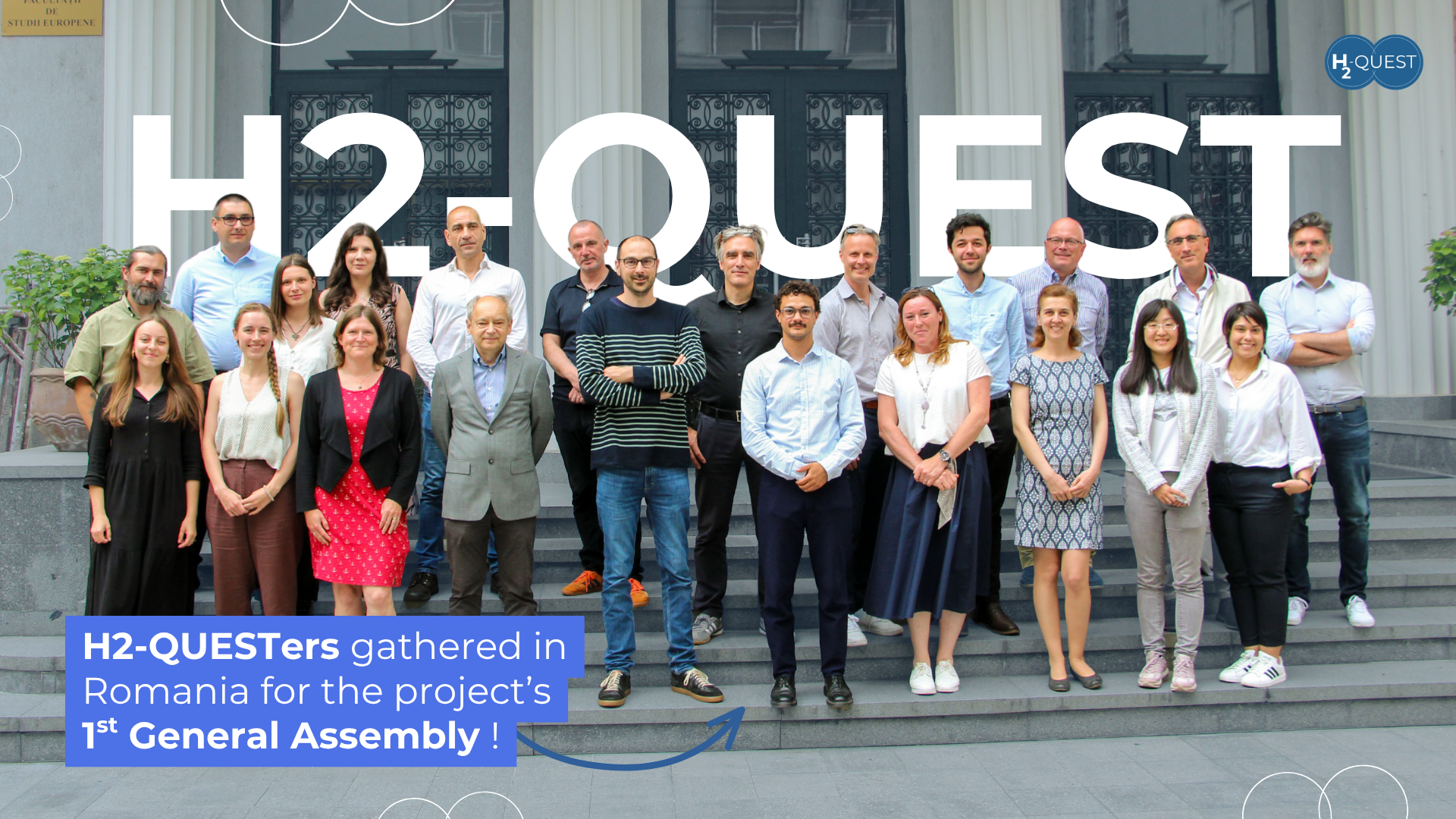
The map of European energy sovereignty is being redrawn based on the foundations of structural geology and international scientific cooperation. The transnational H2-QUEST consortium recently held its first General Assembly in the historic city of Cluj-Napoca (Romania). This technically advanced meeting marked a strategic milestone for the project, consolidating initial analytical progress and standardizing methodologies for the exploration, detection, and subsequent evaluation of natural hydrogen systems (commonly referred to as “white” or “geological” hydrogen) across the European continent.
Organized and coordinated by Babeș-Bolyai University, the two-day in-person meeting provided international partners with the ideal opportunity for multidisciplinary discussion. Given the growing demand for energy consulting based on high-precision data, the scientific core of H2-QUEST lies in answering a fundamental question for the ecological transition: What are the exact mechanisms of generation, migration, and accumulation of free hydrogen in different subsurface geological environments? To address this question, the consortium has brought together expertise ranging from analytical geochemistry and reservoir science to advanced numerical modeling approaches and geophysical exploration technologies.
Analytical Innovation at the ENGAGE-LAB Facilities
In the lead-up to the strategic planning sessions, researchers from the consortium—including the technical delegation from the Aragón Hydrogen Foundation (FHa)—conducted a technical visit to ENGAGE-LAB, located at the Faculty of Environmental Sciences and Engineering at Babeș-Bolyai University. This state-of-the-art laboratory serves as a leading center for environmental consulting and the exploration of clean energy resources.
Its scientific team stands out in Europe for its ability to perform high-precision analyses of traces of hydrogen, helium, hydrocarbons, and other gaseous compounds using advanced interpretive methods. Currently, researchers at this center are analyzing the presence of natural hydrogen in complex matrices such as soils, active seeps, surface waters, underground aquifers, wells, and deep rock formations. The laboratory’s expertise has sparked valuable discussions on the standardization of sampling methods to be applied in the various member countries.
The Challenge of Authenticating Geological Hydrogen
One of the most significant topics of debate during the General Assembly was the critical need to distinguish hydrogen of strictly geological origin (abiotic origin) from sources derived from microbial activity or artificial (anthropogenic) industrial processes. The development of reliable isotopic and chemical methods to genetically identify the gas’s origin with certainty is an indispensable requirement for any future sustainability assessment. Not only does it enable an understanding of deep storage systems, but it also provides legal and technical certainty for future commercial exploration activities and investment in transportation infrastructure.
With the aim of building bridges and fostering a strong scientific community, the conference featured external speakers and leading international energy corporations in the clean gas sector. Among the experts who contributed their insights to the consortium were Oakley Turner (Decahydron), Armin Wisthaler (University of Oslo), Victoria Krohl (Equinor), Ketil Djurhuus (NEXT – Natural Hydrogen Exploration Technologies), Lin Ma (University of Manchester), and Jean-Daniel Paris (HYway).
Next Geographic Target: Expedition to the Pyrenees
H2-QUEST is now turning its attention to southwestern Europe. During this year’s summer campaign, the project’s researchers will launch an ambitious field survey campaign in the Pyrenees mountain range (Aragón, Spain). This geological mission will focus on collecting fresh data from soil emissions and fractured rocks to validate the project’s analytical methodologies.
The Aragonese Pyrenees thus stand out as an exceptional natural laboratory and a strategic priority location for mapping white hydrogen in southern Europe. The Aragón Hydrogen Foundation, in line with its commitment to decarbonization and regional technological innovation, will coordinate local efforts to ensure that the data collected serves as the basis for future European predictive models and engineering consulting audits.
The consortium concluded the meeting by expressing its sincere gratitude to the teams at Babeș-Bolyai University and ENGAGE-LAB for their hospitality and for providing impeccable organizational infrastructure that ensures the operational success of the upcoming phases.
