

Hydrogen fuel cells in VET: driving innovation in Aragonese classrooms
The European energy transition demands a profound transformation of the productive fabric and, above all, of the classrooms where tomorrow’s professionals are being trained. Within this scenario, the EU’s REPowerEU strategy projects that green hydrogen will cover 10% of Europe’s energy needs to decarbonize energy-intensive heavy industries and the transport sector. The challenge is not merely technological, but educational: there is an urgent need to train specialized technicians in clean energy vectors.
Faced with the current shortage of specific teaching resources in the sector, the CPIFP Pirámide in Huesca—a member of the National Network of Centers of Excellence in renewable energies—has consolidated its position as a benchmark in applied research. Through the FC2TEACH2 project, funded by the Ministry of Education through European Next Generation funds and developed in alliance with the Escola del Treball (Lérida) and the Comte de Rius (Tarragona), the Huesca-based center is transferring hydrogen fuel cell technology directly into practical vocational training.
“There are barely any educational resources available on the market. Our goal is to position the center as a national reference in learning the full cycle of hydrogen,” explain Ana Ibáñez and Gerardo Martín, professors in the Chemistry department at CPIFP Pirámide.
From Expo 2008 to the hybrid mobility of the future
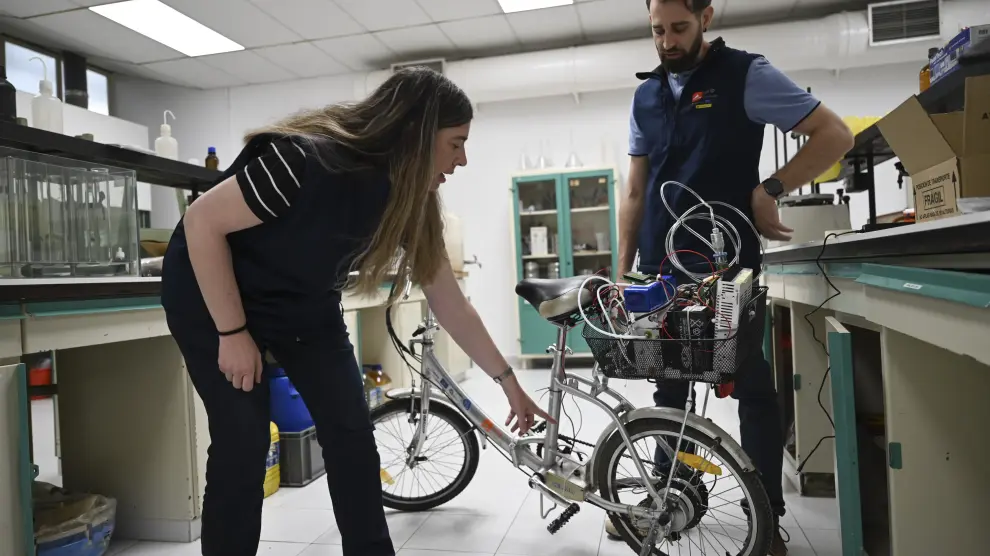
The latest milestone of this institutional collaboration connects the region’s avant-garde past with the future of sustainable mobility. Students and researchers have successfully designed a hybrid bicycle powered by hydrogen and electricity. This was achieved by repurposing one of the experimental vehicles originally deployed by the Aragon Hydrogen Foundation during the Zaragoza Expo 2008.
The mechanical system integrates a metal hydride bottle where the spontaneous reaction between hydrogen and oxygen generates stable electricity at 24 volts through a voltage stabilizer. This energy flow powers the motor and recharges a lithium battery that handles peak power demands. The pedagogical approach is purely active: students receive the disassembled components to autonomously investigate their connectivity and performance.
Innovation at scale: a pioneering pilot plant
After three years of development, the teaching team is finalizing the launch of a mini pilot plant for hydrogen production using alkaline electrolysis technology (from potassium hydroxide). The facility features its own control and data monitoring system equipped with humidity and oxygen sensors that analyze gas quality in real-time.
“It has been a complex challenge because we had to adapt industrial components to an educational scale. We are proud because this type of equipment does not exist in any other Vocational Education and Training (VET) center in Spain,” emphasize Ibáñez and Martín.
In parallel, the center is setting up a hydrogen laboratory equipped with a proton exchange membrane (PEM) electrolyzer. This space will allow students to experiment with energy storage in different types of cells for everyday applications, such as chargers for mobile electronic devices.
Specialization and future employment in Aragon
Looking ahead to the next academic year, CPIFP Pirámide will expand its educational offerings with a second-year course titled ‘Laboratory for the analysis and quality control of hydrogen’, alongside its own specialization program.
Despite fluctuations in the public debate regarding the maturity of the sector, experts agree that green hydrogen will capture strategic niches in mobility and industry. To consolidate this energy ecosystem in Aragon, training highly skilled technical talent stands as the fundamental pillar that must accompany infrastructure investments and regulatory developments.
