

Hydrogen Caravan 2026: The Nexo Journey to Madrid
A driving chronicle from Huesca to Madrid aboard the Hyundai Nexo demonstrates the technical maturity, operational range, and regional integration of Spain’s renewable hydrogen ecosystem.
The silence inside the cabin is broken only by the faint hum of tires rolling over the asphalt of the A-2 highway. Near Medinaceli, the odometer of the Aragon Hydrogen Foundation‘s Hyundai Nexo marks the exact midpoint of the journey without the fuel range indicator suffering the steep, progressive decline typical of intercity trips. At the wheel, Pedro Casero, Head of Innovation at the Foundation, drives with the composure of someone conducting not a constrained laboratory experiment, but a mature, competitive, and fully operational technology in real traffic conditions.
On September 18, within the framework of European Mobility Week, the Aragon Hydrogen Foundation joined the Hydrogen Caravan 2026, an expedition coordinated by Gasnam that brought together fuel cell electric vehicles (FCEVs) from across Spain bound for the Community of Madrid. The central objective of the deployment: to map the tangible progress of zero-direct-emission mobility and evaluate the technical response of the energy vector over long distances.
A Complete Value Chain Overview: From Production to Refueling
The caravan was not merely a vehicular parade, but an analytical field tour through the strategic infrastructure underpinning the renewable hydrogen economy. From generation and high-pressure storage to distribution and final dispensing, the convoy verified the industrial framework that makes zero-emission heavy and light transport possible.
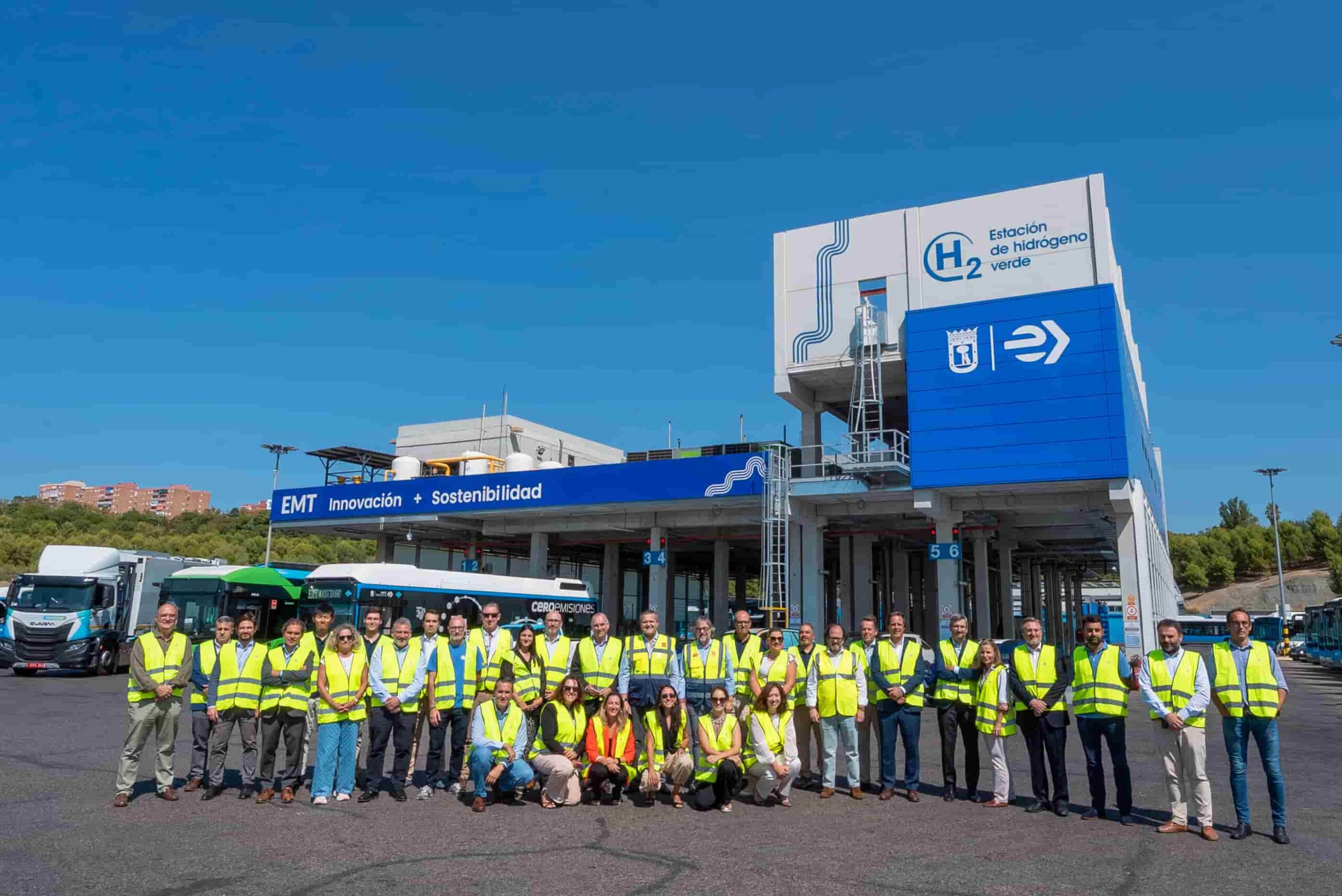
The day began with a key infrastructure milestone: the official inauguration of a new hydrogen refueling station in Algete, a priority node strengthening supply network connectivity in central Spain. Subsequently, the convoy traveled to the EMT Madrid Operations Center in Entrevías. This municipal facility stands as one of the country’s most advanced public complexes, integrating on-site production, storage, and rapid refueling for urban bus fleets at a single location.
Regional Integration and Fleet Maturity
One of the most significant aspects of this edition was its regional cohesion. For the first time, the initiative brought together delegations from six autonomous communities: Galicia, Basque Country, Aragon, Catalonia, Castilla-La Mancha, and Andalusia. This broad territorial representation demonstrates that Spain’s hydrogen ecosystem has evolved beyond isolated pilot projects into a coordinated network of industrial and institutional cooperation.
The participating fleet showcased a wide variety of technologies currently available on the market:
-
Heavy and public transport: Urban and regional buses, alongside municipal waste collection trucks.
-
Commercial production models: High-efficiency passenger cars such as the Hyundai Nexo, Toyota Mirai, and BMW iX5, offering refueling times between 3 and 5 minutes.
-
Cutting-edge prototypes: The first public presentation in Spain of the Toyota Hilux FCEV prototype, targeting the decarbonisation of light commercial vehicles and pick-ups.
Commitment to the Energy Transition
For the Aragon Hydrogen Foundation, completing the Huesca-Madrid route in a fuel cell vehicle represents an ongoing proof of concept. Through its active participation in the Hydrogen Caravan 2026, the Foundation reinforces its commitment to applied research, infrastructure deployment, and knowledge transfer to support the industrial sector in accelerating the decarbonisation of transport.
